

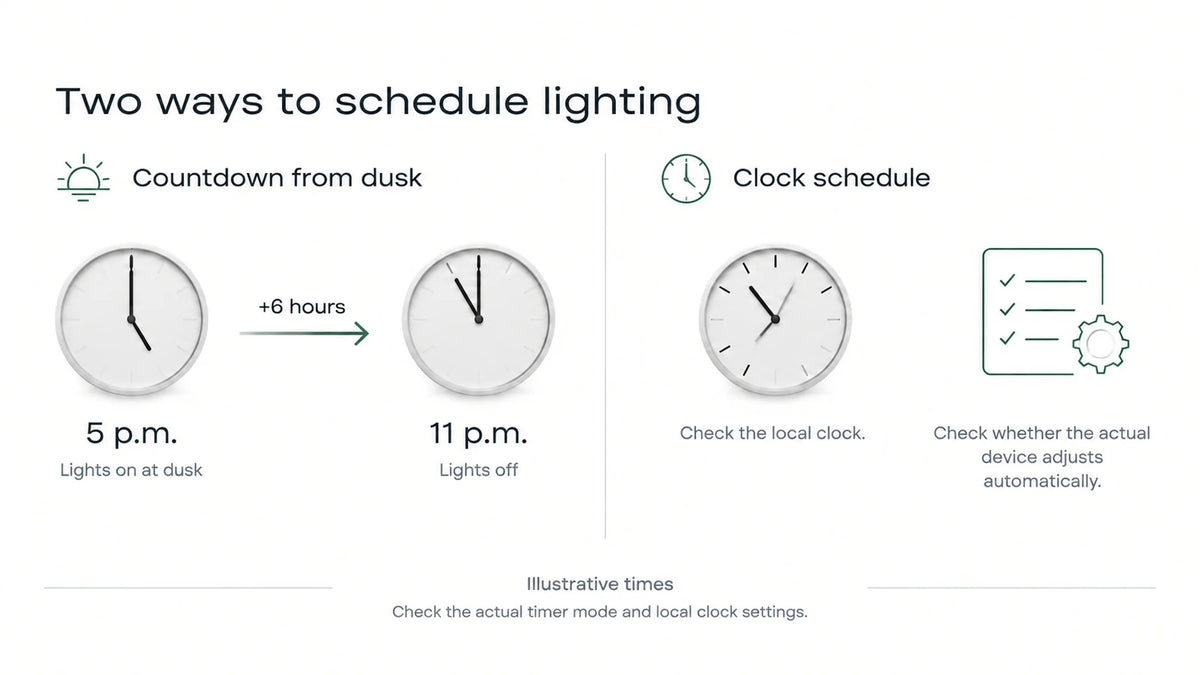
Illustrative times. Confirm the actual timer mode, local clock and whether the device adjusts automatically.
When local clocks move back for daylight saving time, a landscape-lighting schedule may need a check. A photocell follows ambient light; a clock timer follows clock time; a countdown timer runs for a selected duration. This guide explains the difference so you can adjust the mode your actual model uses.
- Clock time check it when your local clocks change
- Photocell responds to ambient light, not the clock
- 6-hour example starting at 5 p.m. ends at 11 p.m.
On this page
What the clock change does
Nothing happens to the dark. It arrives when it did the day before; the clock just reads an hour earlier.
Illustrative example: if the photocell turns on at 5 p.m. and the countdown is six hours, the lights turn off around 11 p.m. Actual turn-on depends on local light and sensor placement; use the observed time at your home rather than an unsourced city sunset table.
Note
If your area does not change clocks, no daylight-saving clock correction is needed. Seasonal changes in daylight may still make a countdown schedule worth reviewing.
The photocell responds to ambient light. After a clock change its switch-on time may appear about an hour earlier on the clock, even though it is responding to the same evening light. The switch-off behavior depends on the selected control mode.
Which kind of timer you have
Look at the settings on the transformer, or on the timer if it is a separate box. Most transformers offer more than one mode, so note which one yours is set to, not only what it can do.
- Countdown timer A number of hours — 2, 4, 6, 8, or a range such as 1 to 11. At dusk the photocell switches the lights on; the timer counts that many hours, then switches them off.
- Clock timer A time of day — a clock face, a dial with pins, or a digital display with a clock. The lights go off at the hour you set, say 11 p.m.
- Dusk to dawn Often marked D-D or D2D. No timer at all: the lights come on with the photocell at dusk and go off at first light.
On ours
Our current 2-zone transformer range is available in 200 W, 300 W and 600 W versions. It supports independent zone control and dusk-to-dawn operation. Check the instructions for your exact model before setting a timer: a countdown after dusk and a fixed clock time are different modes.

What to change when the clocks go back
Countdown timer: nothing
The selected duration stays the same, but the clock time at which it ends moves with dusk. For example, six hours after a 5 p.m. start ends at 11 p.m. Review whether that duration still covers the hours you need; adjust it only using a mode supported by your model.
Clock timer: set it back one hour
A clock timer that does not adjust itself for daylight saving time will still be on summer time on Sunday morning, an hour ahead of every other clock in the house. Left alone, it turns the lights off at what it thinks is 11 p.m. and what is really 10. Set its clock back one hour: on a dial timer, turn the dial until the arrow points at the right time; on a digital one, use the clock button. If yours adjusts for daylight saving time on its own, look at it on Sunday evening anyway.
Dusk to dawn: nothing
In dusk-to-dawn mode, runtime follows the period of darkness and usually grows as winter nights lengthen. Check whether all-night lighting is appropriate for the location and how the sensor behaves in the installed position.
How to set it
- Give the photocell a view of the sky. It should see the open evening sky, not a porch light, a streetlight or the glow of a window. A photocell that sees another light thinks it is still day and keeps the lights off; one buried in a shrub thinks it is night and turns them on early.
- Pick a schedule. Choose the hours when people use the space. If your controller uses a countdown, observe its dusk start and select a suitable duration; a fixed bedtime such as 11 p.m. will not stay fixed across seasons without adjustment or a clock-based mode.
- Test it. Cover the photocell with your hand or a piece of tape. The lights should come on, sometimes after a short delay. Uncover it and they should go off again.
- Check it after a power cut. Some transformers keep their settings through an outage; an older dial timer loses its place and has to be set again.
A countdown timer through the year
A countdown keeps a duration, not a fixed bedtime. As a simple example, six hours from 5 p.m. ends at 11 p.m.; the same six hours from 8 p.m. ends at 2 a.m. These are illustrative start times, not sunset observations for a city.
Twice a year
Review the duration as daylight changes. Local clock changes are a useful reminder, but you can also check it whenever your household schedule changes.
A clock timer can keep a fixed switch-off time. Check its clock, daylight-saving setting, power-outage behavior and any separate switch-on setting according to its instructions.
Two schedules on one yard
One timer means one schedule for everything on the run. The walk lit until the last person is home and the trees off at ten is two schedules: a two-zone transformer with a timer for each zone, or two transformers. The transformer guide covers sizing each zone.
Questions people ask
Do I need to change my landscape lighting timer when the clocks change?
Check a clock timer that does not adjust automatically whenever your local clocks change. A photocell does not need a clock correction, and a countdown keeps its selected duration, but the resulting switch-off time may no longer match your needs. Confirm the mode and settings for your model.
Why do my landscape lights turn off too early?
Three usual reasons. A clock timer that was not set back after the clocks changed turns the lights off an hour early. A countdown timer set in summer runs out earlier by the clock in winter, because dark comes sooner. And a photocell that can see a porch light or a streetlight may switch the lights off when that light comes on.
How long should landscape lights stay on?
Most people run them from dusk to around eleven. There is no rule; the point is to have them on while people are coming and going, and off once the house has gone to bed.
Where should the photocell point?
At open sky, away from porch lights, streetlights, security lights and the headlights of cars turning into the drive. If the transformer hangs under an eave, make sure the photocell is not in the eave's shadow.
Not sure which timer yours is? Email support@hiboitec.com with a photo of its settings and your order number. We reply within one business day.


