

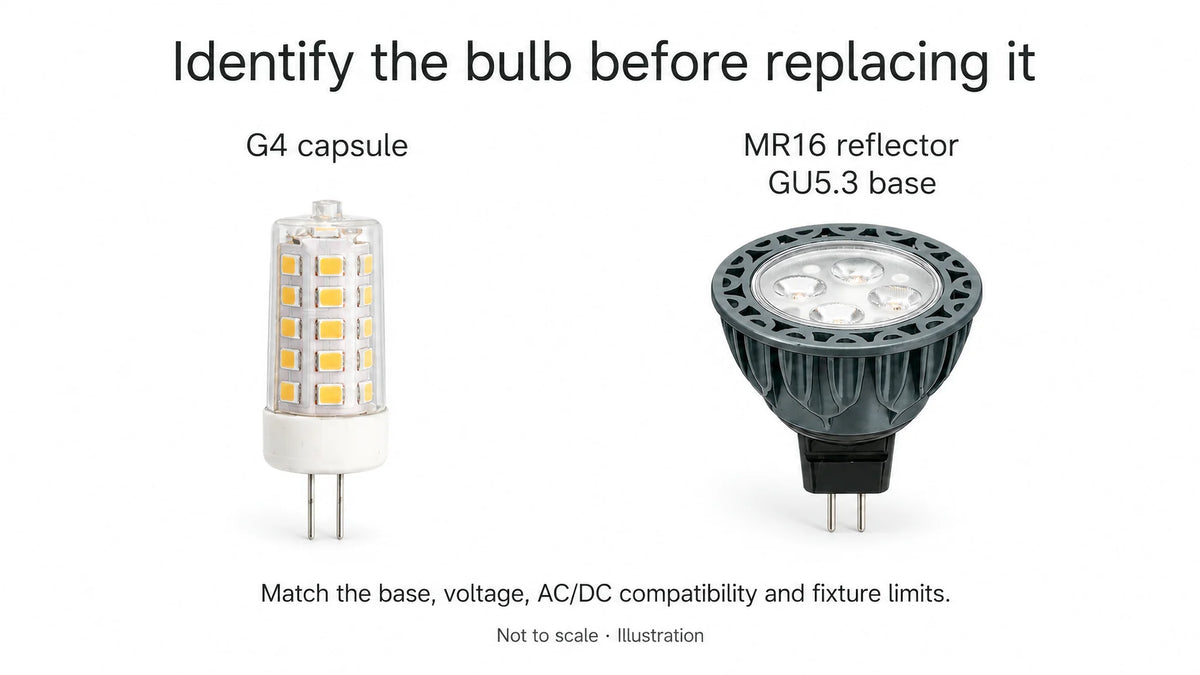
Identification illustration, not to scale. The MR16 bulb shown uses a GU5.3 base. Confirm bulb shape, base, voltage and AC/DC compatibility for the exact fixture; MR16 shape alone does not establish compatibility.
A light with a socket is built for this: the fixture stays in the ground and only the bulb changes. It is a few minutes at the fixture. Two things come first — making sure it is the bulb, and getting the right one.
- G4 in path lights: a small capsule on two thin pins
- MR16 in spotlights: a cup with a GU5.3 base
- Check compatibility base, input, load, fit and fixture instructions
On this page
Is it the bulb?
First disconnect the transformer or kit supply and let the lamp cool. A known-working bulb can be used for a swap test only if it is compatible with the fixture. Restore power after the fixture is closed; if the light still does not work, check the connector, lead and fixture rather than declaring the original bulb sound. See one-light troubleshooting.
Which bulb
- G4 A small capsule with two thin, straight pins close together. Our path lights take a G4.
- MR16 A cup-shaped bulb about two inches across, with two pins on the back; the base is called GU5.3. Our spotlights take an MR16.
Use the fixture instructions to confirm the base, accepted voltage and AC/DC type, permitted lamp load, dimensions and any enclosure or control restrictions. Then match color temperature and beam spread for a consistent appearance. A matching socket alone does not prove that an LED retrofit is suitable.
Where to get one
Our bulb collection currently lists a 5 W, 12 V MR16 LED bulb with a GU5.3 base and 2700 K light. G4 replacement bulbs are not currently listed. Check the fixture instructions for the approved electrical specifications, wattage and physical fit before selecting a replacement.
A G4 bulb in a path light
- Disconnect the power supply before opening the fixture or touching the bulb. Let a recently lit lamp cool, and follow the exact fixture instructions; low voltage is not a reason to work on an energized socket.
- Unscrew the cap by hand. Nothing else moves: the stake stays in the ground and the lead stays joined to the cable.
- Pull the old bulb straight out of the socket, holding it by the body. A G4 does not twist; it slides out on its pins.
- Push the new one straight in, all the way, pins square to the socket. A bulb that is only half in will flicker.
- Check the gasket before the cap goes back on: clean, whole and sitting in its groove. A pinched or gritty gasket is how water gets into the head.
- Screw the cap back on, turn the run on and look — at dusk, or with the timer set to manual on.


An MR16 bulb in a spotlight
- Disconnect the power supply and let the lamp cool. Check the fixture's opening and resealing instructions before proceeding.
- Open the front. On most spotlights the ring that holds the glass unscrews; the fixture stays on its stake, aimed where it was.
- Pull the bulb straight out, holding it by the rim. The two pins at the back come out with a firm, straight pull.
- Push the new bulb in until it sits flat, then check the seal as for a path light and close the front.
- Turn the run on and check the aim. If the head was nudged while you worked, now is the time to put it back.

If there is no bulb
Our current recessed deck, rail, in-ground, hardscape and pond models use integrated LEDs rather than the G4/MR16 bulbs described here. Do not open a sealed LED assembly unless its service instructions permit it. Contact support@hiboitec.com with the order number, model and a photo to identify the repair or replacement route; see the warranty terms.

Keep a spare
A bulb that fails on a January evening is easier to change from a drawer. One spare for each kind of bulb in the yard is enough.
Questions people ask
What kind of bulb do landscape lights use?
The lamp depends on the model. Our current Pagoda, China Hat and Bollard path lights use G4, and the replaceable-bulb spotlight uses MR16 with a GU5.3 base. Other fixtures may use different lamps or integrated LEDs. Check the exact product rather than choosing by fixture category alone.
Can I put a brighter bulb in a landscape light?
Stay within the fixture's approved lamp specifications and the supply's total and per-circuit limits. Brightness depends on lumens and optics, not only watts. Check physical fit, operating compatibility, color temperature and beam angle before changing lamp type.
Do LED bulbs work in old halogen landscape lights?
An LED retrofit can work when the lamp is approved for the fixture's base, input voltage and AC/DC type, dimensions, enclosure and controls. Check transformer minimum-load and compatibility requirements too. A matching base and nominal voltage are only part of the check.
Can you replace the LED in an integrated landscape light?
An integrated LED does not take the plug-in G4 or MR16 bulbs covered here. Whether an LED module can be serviced depends on the model. For HIBOITEC sealed integrated fixtures, contact support for the appropriate repair or replacement rather than opening the sealed assembly.


