

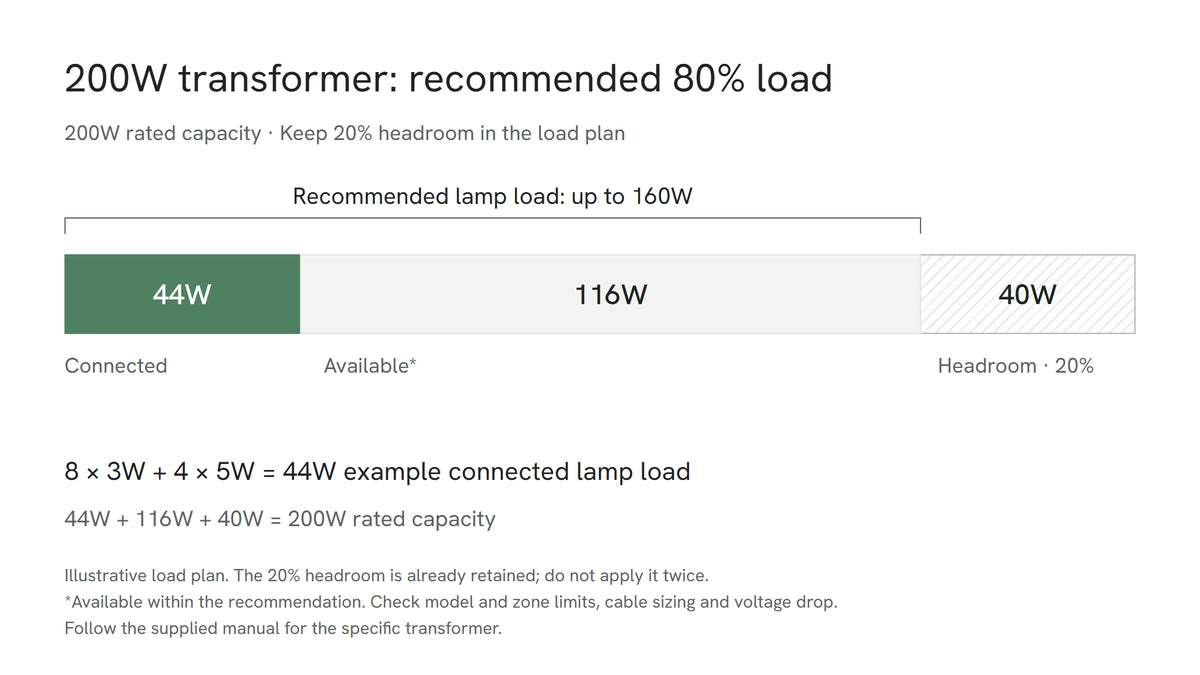
Illustrative load plan for the referenced HIBOITEC dual-zone models. Rated capacity: 200W. Recommended lamp load: up to 160W (80%), retaining 40W of headroom. In this example, 8 × 3W + 4 × 5W = 44W connected, leaving 116W available within the recommendation. Do not apply the same headroom twice. Follow the supplied model-specific manual and check per-zone limits, cable sizing and voltage drop before adding fixtures.
Every yard gets a second round of lights: the tree that finally got big enough, the side path to the trash cans, the new bed. Adding them is simpler than the first install, but the order matters — the transformer first, then where the new lights join the cable, and only then which lights. This page goes in that order, and ends with what to check when the system in the ground is one you did not put in.
Before altering a run: disconnect the transformer or kit supply. Complete the connections and covers before restoring power for the test.
- 200 W rated capacity in this example
- 44 W connected before the proposed additions
- 116 W available within the recommended 160 W lamp-load allowance
On this page
How much room the transformer has
Three numbers: the transformer's rating, what is already on it, and what you want to add.
- The rating Read the actual transformer label and manual, including any per-zone limit. The current HIBOITEC standalone dual-zone range is 200 / 300 / 600 W.
- What is on it now The watts of all the lights on the run, added up. Ours are on each product page; on older lights that take a bulb, the watts are usually printed on the bulb.
- The planning allowance On the 200 W model illustrated here, recommended lamp load is up to 160 W (80%), retaining 40 W of headroom. Later additions use the remaining space within 160 W; they do not consume the retained 40 W. Check voltage drop and each zone separately. The transformer guide explains the calculation.

Start with the illustrated 44 W connected load: eight 3 W path lights and four 5 W spotlights. The 200 W rated transformer has 116 W available within the recommended 160 W lamp-load allowance. As an expansion example, add two compatible 5 W spotlights and four compatible 3 W path lights, for 22 W more. The dedicated DC deck-light kit is excluded from this circuit.
| Load plan | Watts |
|---|---|
| Already connected | 44 W |
| Two additional spotlights at 5 W | 10 W |
| Four additional path lights at 3 W | 12 W |
| Connected after these additions | 66 W |
| Still available within the recommended allowance | 94 W |
| Headroom retained | 40 W |
| Rated transformer capacity | 200 W |
The proposed 66 W total leaves 94 W within the recommended 160 W lamp-load allowance, while 40 W remains as headroom. This arithmetic alone does not establish that the installation can accept the additions: confirm compatibility, per-zone loading, cable sizing and voltage drop before connecting them.
If the old lights are halogen
Older systems ran halogen bulbs, which draw several times what LED ones do: the 5 W LED MR16 we sell is made to replace a 50 W halogen one. Changing the old bulbs for LED ones with the same base frees most of the transformer's rating — often enough for everything you meant to add, with no new transformer at all. Keep the color matched across the yard, 2700 K next to 2700 K.
Where the new lights join
Look at where the new lights go against the cable that is already in the ground.
- Past the end of the run Dig up the capped end, join a new length of cable to it with a sealed connector, and carry on along the new route.
- Beside the run A new light within reach of the cable joins it where the cable passes, the same way the others did; its lead covers the last few feet.
- Somewhere else entirely A bed on the far side of the lawn, or the back yard when the run is in the front: a second cable from the transformer, rather than a long detour on the first one. Two short runs stay brighter than one long one.

Three ways in: past the end of the run, beside it, or on a second run from the transformer.
Watch the far end
More lights, or more length, on a run that was already long can dim its last lights. Test with the new lights connected before anything is buried: if the end of the run looks dimmer than the start, the wire guide has the fixes in order.

When it will not fit
If the additions exceed the manufacturer's total or circuit rating, stop and redesign the supply and layout. Going above the example 80% planning allowance calls for a review; it does not by itself prove that a second transformer is required. Separate schedules may call for independent zones or supplies. See the transformer guide.
A system you did not put in
A house that came with lights in the ground is still a 12 V system you can add to. Three checks first.
- The electrical requirements Match every new fixture to the actual output: voltage range, AC or DC, connector type and circuit capacity. A kit that requires its supplied adapter must remain a separate system unless its instructions allow another supply. Household-voltage fixtures are outside this guide.
- How much room it has The same arithmetic as above, with the old fixtures counted at their real watts. If they are halogen, the bulb change above usually makes the room.
- The state of the cable Two-conductor landscape cable, with the gauge printed on the jacket. Splices that were twisted and taped are where old systems fail; redo any you uncover while you are digging.
Other lights on ours
When adding another maker's fixtures, check their input requirements against the transformer output and the instructions for both products. Our current 2-zone transformer range has 12 V / 14 V AC outputs. A fixture or kit that requires its own 12 V DC supply is not interchangeable simply because both are described as low voltage.

Questions people ask
Can I add more lights to my existing landscape lighting?
Only if the added fixtures are electrically compatible and the total and per-circuit loads remain within the manufacturer's limits. Recheck cable voltage drop and connector capacity. The 20% reserve in this example is a planning allowance, not a universal maximum.
Can I mix LED and halogen landscape lights on one transformer?
Compatible LED and halogen fixtures may share a supply when its instructions permit the combination and the loads stay within its limits. Check minimum-load or control requirements as well as maximum load. An LED retrofit must suit the fixture, not just reduce the wattage.
Can I use a different brand of landscape lights with my transformer?
Sometimes. Match the permitted input voltage and AC/DC type, connector and cable requirements, controls and power-supply ratings. A 12 V label alone is not proof of compatibility. Keep dedicated-power kits on their specified supplies unless their instructions allow otherwise.
How do you add a light to the middle of a run?
The same way the other lights joined it: the new fixture's lead joins the main cable at that point with a sealed connector. One new light within reach of the cable does not need a new run.
Not sure what your transformer can take? Email support@hiboitec.com with a photo of its label and a list of the lights on the run. We reply within one business day.


