

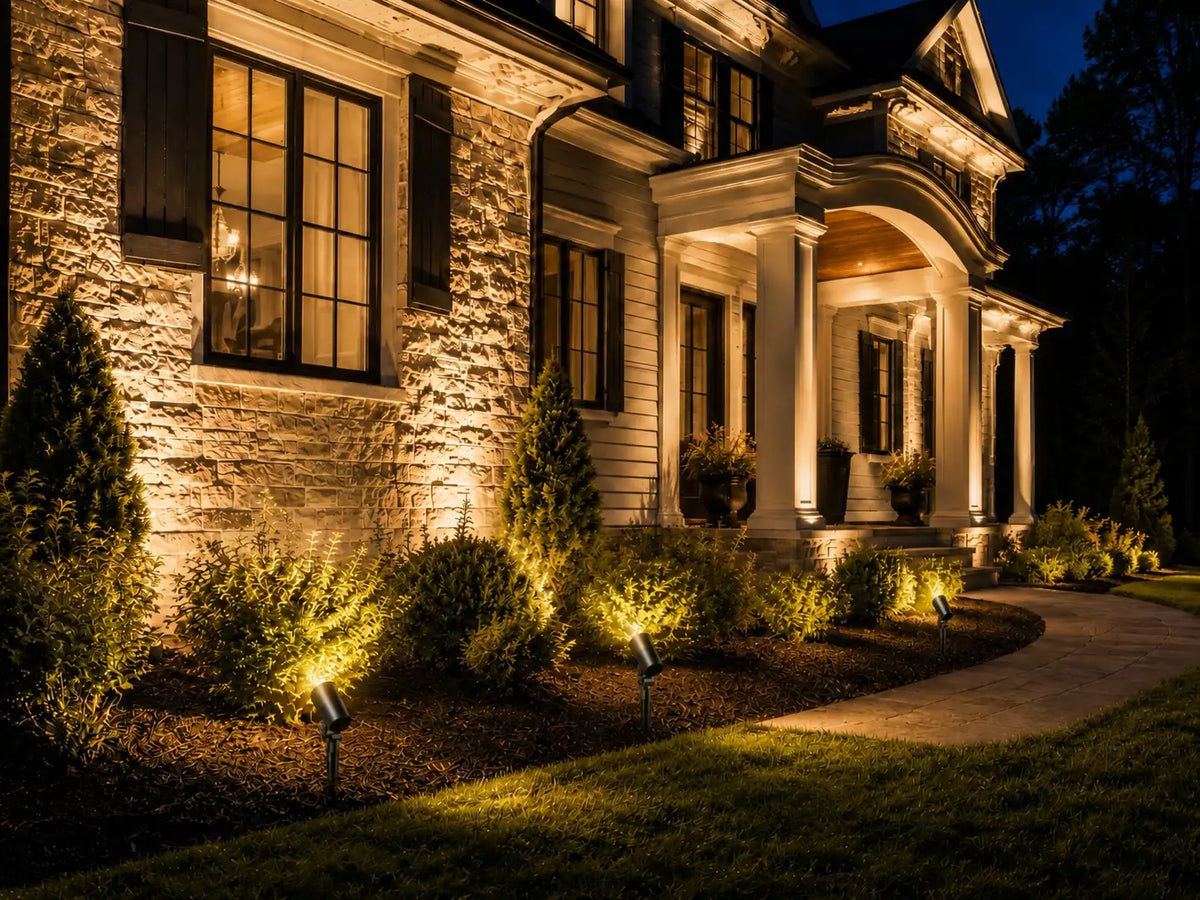
There is no single best path light. There is a best one for a straight front walk, a different one for a curved path through a bed, and a third for the steps — and for a short sunny path with no outlet, the honest answer is not a low voltage light at all. This page goes walk by walk.
What every good path light has in common comes first, because it is what to check on anything you buy, from us or from anyone.
What makes a path light good
- The light lands on the ground. Look for a hat or hood that directs light toward the walk. Anti-glare design does not remove the need to check placement: view the actual fixture from normal standing and seated positions, and adjust its position if the source remains exposed.
- Check the body and outdoor rating. Material, coating, installation conditions and maintenance all affect durability. A path light can be struck by a mower or shovel regardless of material; compare the product's construction and rated conditions rather than assuming a material guarantees service life.
- The color is warm. 2700 K on a walk, 3000 K at most. Cooler than that reads as a parking lot.
- Check how it is serviced. The illustrated HIBOITEC China Hat and Pagoda models use replaceable G4 lamps. Other models may use a different lamp or an integrated LED assembly. Confirm the exact lamp base, voltage, input type and service instructions before buying a replacement.


Best for a straight front walk
A hat-style path light can suit a straight front walk. One-sided placement is a useful starting layout for a narrow path. Six positions at 8-foot intervals span 40 feet as a layout example; this is not a measured coverage guarantee. Test the actual fixtures after dark before fixing the spacing.
Put the first one where the walk meets the drive and the last one at the step, not at the door — the door has its own light. If the walk is wide enough for two people side by side, still light one side; two rows on a residential walk is an airport.
Our pick: the replaceable-bulb path lights — cast aluminum, 3 W G4 bulb, 2700 K.

Best for a curved garden path
A curve needs attention to the edge and changes in direction. Place lights temporarily near the outside of bends, then adjust spacing and side after a night test. A 6-foot spacing is only a planning example; the actual light spread, path width, planting and viewing positions determine the final layout.
In a planted bed a slightly taller fixture helps once the perennials come up in June; a low light in tall plants lights the plants and not the path.
Our pick: compare the path-light models and test the layout around the actual bends.

Best for steps and level changes
A step needs light on the tread and a visible edge. Choose a fixture approved for the mounting surface, and test the layout before drilling. Our 2.5 W Half-Moon rail light and our Recessed Deck Light 16-Light Kit are different products: the recessed kit uses its included 12 V DC supply as a separate run. Do not connect that kit to the path-light cable.
Where a walk meets a single step, one recessed light in the riser does more than the two path lights either side of it.
Our pick: compare the options in Patio, Deck & Steps, then follow the mounting and power-supply requirements for the exact product.
Best for a driveway edge
A driveway edge can be struck by a mower, snowplow or tire. Compare fixture height, construction and outdoor rating, and set it outside those routes. Choose spacing after testing the actual light; marker lighting and lighting for a walking route have different jobs.
Skip the tall ornamental fixtures here. They look right in the catalog and lean over by the second winter.
Our pick: from the pathway and driveway collection, the short-stem cast aluminum fixtures.
Best for a short sunny path with no outlet
Solar. If the path is short, in full sun most of the day, and the nearest outdoor outlet is on the other side of the house, a low voltage run is more system than the job needs, and we will say so. What solar cannot do — shade, short winter days, one brightness every night — is in solar vs low voltage, so you can decide with the trade-offs in front of you rather than after the first November.
What to skip
- Unclear serviceability. Check whether the lamp or LED module is replaceable and how other parts are serviced. An integrated LED failure may require an assembly replacement, while a cable or connector fault may not involve replacing the light at all.
- Plastic stakes. They snap the first time the ground freezes around them.
- Anything cooler than 3000 K. Daylight white on a residential walk makes a house look like it is for sale.
- Copying a layout without testing it. Start with one side on a narrow walk, then check coverage and glare at night. A wider or curved path may need a different arrangement.
How many to buy
For an initial count with lights at both ends, divide the path length by the chosen maximum interval, round up, then add one. A 40-foot path at no more than 8-foot intervals needs six positions; at no more than 6-foot intervals it needs eight. This is layout arithmetic, not verified light coverage. Test the actual fixtures, then include steps and other planned lights in the load calculation. Plan my yard can help organize the count.

Questions people ask
What are the best low voltage path lights?
For a home walk: a hat-style fixture that puts the light on the ground and not in your eyes, cast in metal rather than plastic, at 2700 K, with a bulb you can take out and replace. That combination is what the picks above have in common. The rest — height, finish, spread — depends on the walk.
How many path lights do I need for a walkway?
For a layout with lights at both ends, divide the path length by the chosen maximum interval, round up, then add one. A 40-foot path needs six positions at no more than 8-foot intervals or eight at no more than 6-foot intervals. Adjust the count and sides after checking the actual fixture coverage, glare, path width and turns at night.
Brass or aluminum path lights?
Brass and aluminum differ in weight, finish and how their surfaces age. Light on the ground also depends on the shade, optics, lamp and mounting height; material alone does not make two fixtures perform the same. Compare the specifications and finish you want for the actual installation.
How far apart should path lights be?
There is no universal spacing. A 6–8 ft interval can be a starting point for a trial layout, but the actual fixture, lamp, mounting height, path width and surface determine coverage. Check the full route and normal standing and seated sightlines after dark before setting the final positions.
Next
Path lights — cast aluminum, replaceable G4 bulb, 2700 K
Next: how to install low voltage landscape lighting


